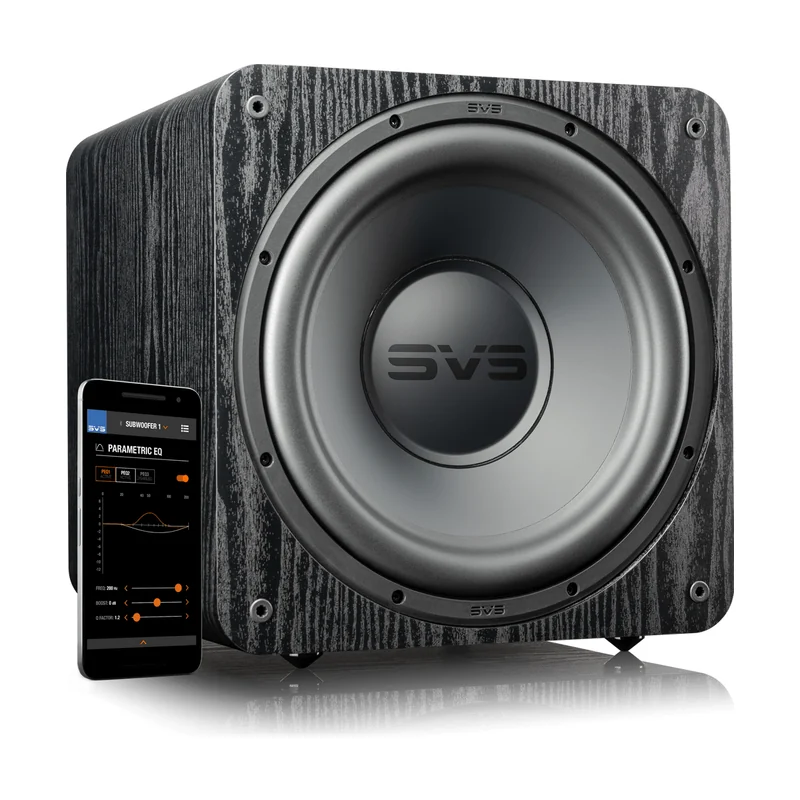
Subwoofers: the turnkey setup, and where to buy it

If you want one answer rather than a research project: buy four SVS SB-1000 Pro subwoofers and put one in each corner. That beats a single sub costing the same as all four, and it beats it on the thing that actually bothers you — bass that changes from seat to seat.

Why four, before anything more expensive

One sub has one pattern

A subwoofer excites the room’s modes according to where it sits, producing one fixed pattern of peaks and nulls. Every seat lives somewhere in that pattern, and a bigger sub in the same spot plays the same peaks and nulls — louder.

Corners drive every mode

Every room mode reaches maximum pressure in the corners. Put a sub in each of the four and the pairs along each axis work against one another’s odd-order modes, which is what flattens the seat-to-seat variation rather than just the average.

Four cheap beats one expensive

Four SB-1000 Pros cost about what one flagship sub does, and they buy the thing a flagship cannot: independent positions. Output was never the problem if your bass is boomy in one chair and thin in the next.

Two subs is the biggest single step and a perfectly good place to start — the full argument, including where the returns flatten out and the one case where a single sub is genuinely enough, is in why four affordable subwoofers beat one expensive one.

The pick

The SB-1000 Pro is the one we point people at because it is sealed (tighter, more predictable in-room behaviour than a ported box of the same size), it is physically small enough that four of them are actually livable, and each one has its own DSP with delay and parametric EQ — so Perfect Soup has real controls to solve against.

Prices are checked once a day and shown with the date we read them; they exclude tax and shipping, and the dealer’s own page is always right if the two disagree. Many retailers don’t publish a machine-readable price, so those simply link through. We may earn a commission from some of these links, at no cost to you — it never affects which gear we recommend.

Placing them

  • One per corner, on the floor. Start there. It is the layout that most reliably generalises across real rooms.
  • Never stack two in one corner. As far as the room is concerned that is one louder sub: same position, same nulls. You would be spending a smoothness tool on about 6 dB of level.
  • Don’t hand-tune the integration. Four subs plus your mains is a joint problem — every level, delay and crossover you change moves the target for all the others. Measuring and solving them together is the entire point.
  • Measure after, not just before. The reason to add subs is what they change at your seats, so verify it there.

Making four subs behave as one system

Buying the hardware is the easy half. Perfect Soup measures every speaker and every sub from dozens of positions around your listening area and solves the whole system on GPUs — levels, delays, crossovers and response together, each correction aware of what every other source is doing.