Perfect Soup vs SoundID Reference, ARC Studio, and Dirac ART
Four names come up when people shop for room correction: Sonarworks SoundID Reference, IK Multimedia ARC Studio, Dirac Live ART, and — because you are reading our blog — Perfect Soup. We make Perfect Soup, so we are not a neutral party — but every claim below is either about how these tools are built or comes with a number you can check. What differs, what it costs, and one measurement from a customer’s room.
The useful thing to know up front is that this is two different comparisons, not one. Against SoundID Reference and ARC Studio, the difference is structural — they correct each speaker on its own, and we solve every speaker together. Against Dirac ART it is not structural at all: ART is genuinely a multi-speaker system, built on the same core idea we are. There the differences are price and how deep the cancellation goes.
SoundID Reference and ARC Studio: per-channel correction
Both are measurement-based, and both do the same fundamental thing: they measure your speakers and correct each channel independently toward a target curve. Measure the left monitor, build a filter for the left monitor. Repeat for the right.
That design carries one assumption: that your speakers don’t interact. Above a couple of hundred hertz it is close enough to true — treble is directional and the room absorbs it quickly. Below that it falls apart. At 100 Hz a wavelength is about eleven feet, so every speaker in the room is pressurizing the same air at once. Your left monitor, your right monitor, and your subwoofer all contribute to the level at your ears at 60 Hz. Correct each one in isolation and the corrections can end up working against each other — one channel pushing while the sub is pulling. Nothing did that on purpose; independent optimization simply cannot see an interaction that nothing measured.
Perfect Soup runs a joint solve instead — MIMO: multiple inputs, multiple outputs. It measures every speaker across 30 to 100 positions and optimizes all of them together, so how your speakers combine stops being an assumption and becomes part of the data the answer has to satisfy. That is what makes it possible to use one speaker to help cancel another’s contribution to a room mode, and it is why multiple subwoofers only really pay off when something coordinates them as one system. (The longer version of this argument, without the brand names, is in how correction approaches differ.)
And the price runs the other way from what you would expect. SoundID Reference lists at $249, or $299 bundled with a measurement microphone. ARC Studio runs $299 to $350 depending on the dealer. Perfect Soup starts at $59 for stereo and $99 once you add a support speaker to the solve. So the joint approach is not the premium option here: it is the cheaper one, by a factor of three or more at the entry point. The tier most 2.1 studios settle on, Project Studio at $199, is still below either of them.
Dirac ART: the closest architecture to ours
Dirac Live ART — Active Room Treatment — is the one product here in the same family as our joint solve: it uses the speakers in your system to actively cancel room resonances rather than only equalizing each one. We are not going to claim we are the only multi-speaker option, since we aren’t. So against ART the comparison moves off architecture and onto two things you can check:
- Price. Ours starts lower, and by a wide margin at the entry point. Table below.
- How far the cancellation goes. This is the interesting one, and it is the only claim here we can show rather than assert.
One customer’s room, measured three ways
A customer sent us this. It is their room, their measurement microphone, and their copy of REW — the same room measured in three states, with identical spectral-decay settings each time (20 ms slices, 500 ms window, 100 ms rise time): traditional EQ, then Dirac ART, then Perfect Soup.
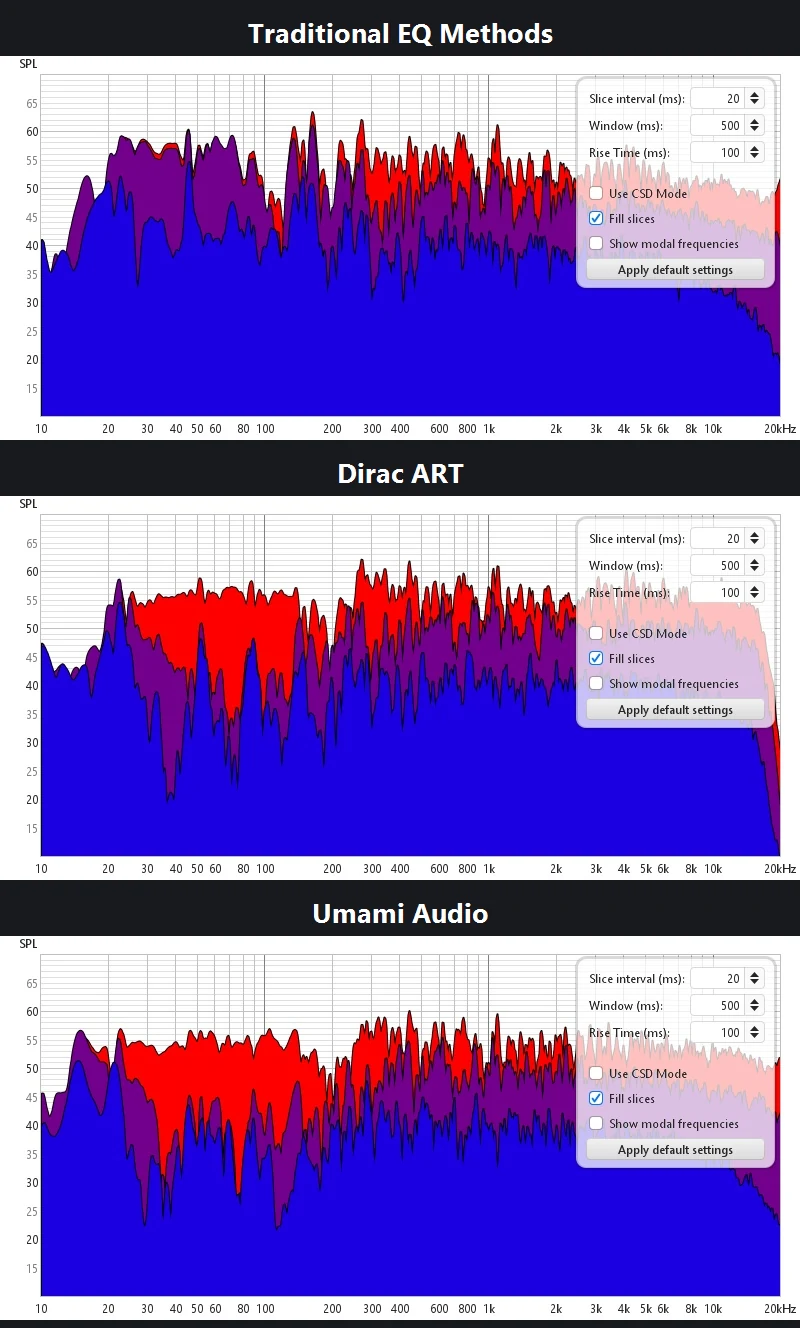
Read the panels top to bottom. Under traditional EQ the traces sit almost on top of each other below about 200 Hz: the level has been rebalanced, but the energy is still in the room when the window closes. That is the honest limit of equalization. It changes how much energy goes in, not how long the room holds it. Higher up, above roughly 250 Hz, all three panels show the room decaying on its own — that region isn’t what any of these tools is fighting over.
Dirac ART changes the picture. Through the modal region — roughly 25 to 200 Hz — a wide band opens up, and the late-energy floor drops well below the early response. That is active cancellation doing exactly what it claims.
Perfect Soup opens the band slightly wider, and more usefully opens it in different places. It starts cancelling lower: the band opens around 23 Hz rather than 26 Hz. The late-energy floor sits clearly lower in two ranges, roughly 23 to 32 Hz and 100 to 160 Hz. Between about 36 and 80 Hz the two are close and ART is lower in places, so if that octave is where your room misbehaves, this measurement does not say we win it.
One thing worth pre-empting, because it is the obvious objection: a wider decay band could just mean we are playing louder. It isn’t that. Our early-response level sits about a decibel below ART’s across the modal band, so the extra separation is decay, not gain.
The caveat, stated plainly: this is one room. One customer, one geometry, one speaker layout. It is a real measurement rather than a simulation, and it was taken the same way three times, which is what makes it worth showing — but a single room cannot prove a general result, and we are not going to pretend it does. Your room has its own modes, and the only measurement that settles anything for you is one taken in it.
What it costs
Multi-speaker cancellation is the expensive feature in this category, so it is the fair thing to price against. One detail matters when you compare: ART is not sold on its own. It is an add-on that requires the full-bandwidth Dirac Live Room Correction license underneath it, so the $299 figure is an upgrade price for people who already own that. With us, the capability is simply set by how many support speakers a tier allows.
| License | Price | What you get |
|---|---|---|
| SoundID Reference | $249 | Per-channel correction ($299 with a measurement mic) |
| ARC Studio | $299–350 | Per-channel correction, hardware unit |
| Dirac Live Room Correction | $349 | Required before ART can run — full-bandwidth license |
| Dirac Live ART | $299 | Multi-speaker cancellation — upgrade only, not sold standalone |
| Dirac ART + Bass Control | $549 | Upgrade for existing Room Correction owners, multi-sub pairing |
| Dirac ART bundle, from scratch | $799 | Room Correction Full Bandwidth + Bass Control + ART |
| Micro Studio | $59 | 2.0 stereo, no support speakers — so no joint multi-speaker solve |
| Mini Studio | $99 | Joint solve, 1 support speaker per group |
| Project Studio | $199 | Joint solve, 3 supports per group |
| Platinum Studio | $599 | Up to 6 groups, 6 supports per group |
| The Perfect Soup | $999 | Unlimited groups and supports |
Read down the table and the gap is hard to miss. Joint multi-speaker correction starts at $99 here. To get ART on a system that doesn’t already run Dirac, the entry price is the $799 bundle, because the $299 upgrade needs the $349 Room Correction license under it before it will do anything. Even our Platinum tier — six groups with six support speakers each — lands at $599, under that bundle. Only The Perfect Soup at $999 goes above it, and it lifts every limit. Every tier has a 24-month payment plan too. (Full detail on the pricing page.)
Two details make those tiers more flexible than the row in the table suggests. First, a support doesn’t have to be a subwoofer. It is any speaker the solve is allowed to use as an extra source, so a sub counts, and so does a spare monitor or a second pair you already own. If there is an idle speaker in the room, it can be put to work flattening the low end instead of sitting there.
Second, the licenses expand. You are not stuck with the tier you bought. Adding Extra Support is $59 once and permanently adds one more support to every group — so a Mini Studio license and a second subwoofer is $99 + $59, rather than a jump to the next tier up. You can also trial that add-on free for 30 days, twice a year, from your dashboard before you decide. And if you do outgrow a tier, moving up costs only the difference, so nothing you already paid is wasted. Start where your room is now and grow the license with the system.
Updates are free for life, and that means algorithm updates, not just bug fixes. When the solver gets better at a problem, your existing license gets the better solver — you don’t buy the product again to benefit from work we did after you paid. (Re-running a calibration on an improved algorithm needs active calibration access: the year included with every perpetual license, an extension, or a live subscription.)
Where Perfect Soup fits
- Multiple subwoofers. Subs only pay off when something coordinates them as one system. That is the job a joint solve does and a per-channel filter cannot.
- Surround and immersive. Stereo through 11.1.6, with every channel and support speaker solved together rather than one at a time.
- Bass that has to hold up in more than one seat. The correction is fitted across 30 to 100 measured positions instead of extrapolated from one.
- Timing as well as tone. Phase- and time-aware, so crossovers and speaker-to-speaker arrivals get measured and aligned rather than assumed correct.
- A plugin, not another box. It loads on your monitor bus and bypasses itself automatically when you render.*
* Automatic bypass on render is supported in some DAWs, not all.
Don’t take our word for it — 60 days is long enough to be sure
One plot from one room is evidence, not proof, and we would rather you settled this in your own room than trusted our chart. Perfect Soup comes with a 60-day free trial — full featured, no credit card. That is deliberately long. Room correction is not a thing you can judge in an afternoon: you need to measure, listen for a week or two, put a mix through it, come back to references you know well, and hear whether the low end still holds together somewhere other than your chair.
If it does not beat what you are running now, you have lost nothing but the measurement time. If it does, you already know exactly what it does in the only room that matters. Download it and measure your own room.
Prices are from July 2026.